Showing posts with label image. Show all posts

Friday, 24 May 2013

INTERVIEW: Chen Whooli


On first seeing Whooli Chen's illustrations, I was delighted by her unique interpretations of the subject matter and organic, surreal style. Based in Taiwan, she has a MA degree in illustration field from University of the Arts London and has worked on a number of books, newspapers, and magazines.

Whooli very kindly took time to answer a few of my questions.


Who are you and what do you do?
I’m a freelance illustrator based in Taiwan. I do editorial illustrations for newspapers, magazines, graphic books, and collaborations with a variety of companies in different fields. I also run a studio with my sister.

Your work are reminiscent of folk tales and children's stories. Would you agree with this and what stories have influenced you?
I do like old-time atmosphere, and also trying to take that as a key visual element in my works. I love literature.  Dream of the Red Chamber, an 18th century Chinese novel, is my latest amusement.  Angela Carter’s quirky stories are always fascinating.


Would you explain the concept behind "The Travelling Project" and "The Diary Project"?
Don’t have much concept behind “the travelling project” really. It’s created when I was in London. Although stay there as a student, I always felt like as tourist. So detached from the locals, seemed the days they’re living can be called a day-to-day life, rather than mine. So what we did, my sister and I, was travelling  and exploring the city. The drawings were send out as postcards, described our journey in London.

“The diary project” is a collaborative project with 集日美工(365days.tw). A cover of 365days calendar notebook and entitled “Room of one’s own”. It’s about collecting, people collect leaves, coral specimen pieces, oak fruits, and childhood hair. Treasure them as they reflect our memories. Until rooms are filled. However, with a filled room, we ourselves still dream about being collected, in someone else’s room.


For your editorial illustrations, you have a unique approach to the subject matter. How do you develop these sorts of illustrations and how much freedom are you given?
Editorial illustrations are for magazines and newspapers. After I got a story form editor, I’ll read it thoroughly   then pick the elements out and give the connection between them, story becomes the frame, and hopefully the relation of every little elements can be depicted and reveal the story, therefore illustrate the frame. I am always trying to find a new approach to every story, a new way to construct, to express, or, even an interpretation. As long as the illustration meets the gist of the story, and understandable. I’ve been completely trusted.


How did you develop your skills and what would you say has been the most important thing you've learned in your career?
I studied fine art before I got a MA degree in illustration. There is a fine line between these two disciplines, in training and in the way of expression as well.

When you were in school, especially in Taiwan, every assignment was about to improve your technical skills, and your capabilities to manage all the tools. However, when you are twenty, that was the whole thing you’d sniff at, ... conventional, academic,... If, there were any heritage left, I’d say, it has made “the career” much approachable.
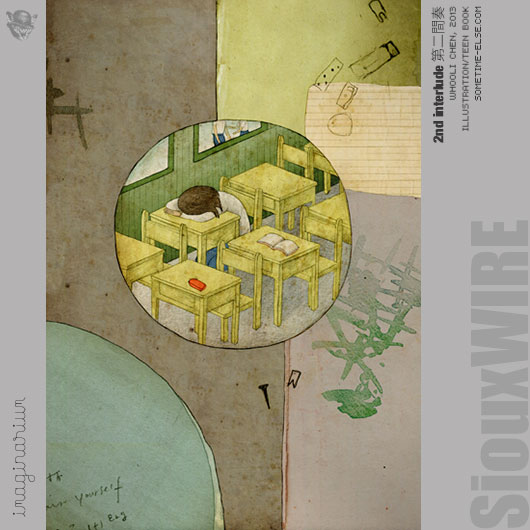


What is the significance of animals in your work? You have mentioned missing a fox that you knew in London.
“Whooli” is the pronunciation of fox in Chinese. I was living in the top floor of a 19th century yellow brick house in west London  there was a red fox living across the street, sometimes I can see her sunbathing in neighbour’s back yard. I miss her, so take Whooli as a pseudonym name, it’s kind of remind me the London times.

What materials do you use to create your illustrations and why do you use these in particular?
Hand drawing, and digital colouring. Digital can be adjusted  easily, which save some labour for low-paid commissions...


What have been some of your favourite responses to your work?
Poetic, is one of the compliments I enjoy most.

Do you have any favourites or pieces of special importance among the work you've done?
Favourite is always the next one. And, I think my MA graduated project “Land and Tales ” plays the role as a small milestone.


Who is your favourite musician, film maker, painter and writer and why?
Marc Chagall, Rene Magritte, Egon Schiele, Francesca Woodman, Sarah Moon, Sophie Calle, Angela Carter. They are all inspiring and have a remarkable vision in their field of art.

What are you currently working on and what future projects do you have planned?
I’m in the half way of a children’s book. And, some secret projects under the name of our studio, hopefully will come true this year.

Thank you, Whooli.


Links:

Thursday, 23 May 2013

INTERVIEW: Valentina Talijan


Valentina Talijan was born in Belgrade, Serbia in 1989. She is currently studying painting in Novi Sad, Serbia on Academy of Arts, and will graduate in June this year. She has participated in a dozen group exhibitions in Serbia as well as one in France and South Korea. I discovered her work on Behance and really enjoy her Kolaž series.

Featuring art students will become a regular part of the WIRE and Valentina was very charming and down-to-earth in her replies to my questions despite the language hurdle.


What triggers the creation process in you and how does it develop to its completed form?
Before I start to work I intend to collect as much information as I can and to find answers to as many questions about the theme I choose to deal with. I like to think about the wind, or about the immensity of the Universe (thanks a lot Doctor Who). I would say that thinking about constant movement is what triggers creation process in me (related with works presented here). Sometimes the process consists of months of just thinking about something and a few days of materializing the idea. I believe that the art doesn’t just pop out, there is work that every artist must do; if you do not do the work everyone will know it. Regarding this particular series of collages, I spent most of the time dealing with materials that I used.

Outside the media in which you work, what arts appeal to you and/or inspire you and why?
Definitely new media and performance art. New media art because art should represent the time in which it is created and we live in a time of technology. Plus their work is mainly awesome. Because I am in a phase of thinking about the artist as a piece of art, I find it very interesting. The relationship between the audience and the artist as part of the art work (or one of the objects in composition of the space involved in performance) reminds me of Baroque art spaces and the active energy in them.


How would you describe contemporary art in Serbia at the moment?
There are a few who shine. I would say it like that, because I think that my country has too many artists proportionally to its population. Personally I have a lot of respect for the work of Simonida Rajčević and a group of artists called Third Belgrade.

Why make art? 
Honestly I don’t know how to answer that question. I think that I will never find the answer and that’s a good thing. Art is not the only thing that I do, but all of the other things I do are art related.

What are your aspirations in terms of your art?
I am planning to stay for a while on the project on which I am working right now. I think that I have barely made any steps from the start and that there is still a lot of work to do; and I am currently obsessed with the facts about constant motion, I just can’t help it.


Links:
Valentina Talijan


Thursday, 16 May 2013

Amy Bennett's AT THE LAKE


Amy Bennett's At The Lake reminds me of Julio Cortazar's Blow Up. I feel as if I'm looking through a lens and the closer I look, the clearer it becomes that all is not well at the lake. With a style of painting that gives her scene the look of a tilt-shift photograph with people looking vaguely like miniature figures, it has the effect of making each individual look so incredibly isolated. Even in groups (as above), individual isolation seems to be magnified as the Spartan landscape intensifies the odd focus on people despite their diminutive size.

Aside from isolation, the titles imply uncertainty and menace forcing you to investigate further. It's an odd experience seeing her paintings. At first glance or from a distance, they seem vaguely akin to Edward Hopper but perhaps with even brighter colours and optimism. A step closer and the eye senses something isn't right. What scale is this? Are those people or toys? Even closer observation raises more questions and looking for clues in the titles adds to the mystery.

Take the image below as an example. Is the man helping the woman from the lake? Has she passed out? Why isn't she wet? Oh, there's a boat... The title is "Into the Woods". What happened before? What will happen next? I love how these paintings play on our expectations with double edged narratives enhanced so incredibly by Amy Bennett's unusual style.


"Working with common themes such as transition, aging, isolation, and loss, I am interested in the fragility of relationships and people’s awkwardness in trying to coexist and relate to one another. To that end I create miniature 3D models to serve as evolving still lifes from which I paint detailed narrative paintings. Using cardboard, foam, wood, paint, glue, and model railroad miniatures, I construct various fictional, scale models. Recent models have included a neighborhood, lake, theater, doctor’s office, church, and numerous domestic interiors. The models become a stage on which I develop narratives. They offer me complete control over lighting, composition, and vantage point to achieve a certain dramatic effect."


"While working with tiny pieces that often slip frustratingly from my fingers, I am reminded of the delicacy and vulnerability of the world I am creating, and this summons empathy for my subject. The clumsy inadequacies of miniatures help me to convey a sense of artifice and distance.  I try to paint the scenes in a way that feels like a believable world, but an alternate, fabricated world."


"The paintings are glimpses of a scene or fragments of a narrative. Similar to a memory, they are fictional constructions of significant moments meant to elicit specific feelings and to provoke the viewer to consider the moment before or after the one presented in the painting. I am interested in storytelling over time through repeated depictions of the same house or car or person, seasonal changes, and shifting vantage points. Like the disturbing difficulty of trying to put rolls of film in order several years after the pictures have been taken, my aim is for the collective images to suggest a known past that is just beyond reach."


"Throughout 2010 and 2011, I created a mosaic with fabricator Franz Meyer of Munich for MTA’s Arts for Transit. Installation of the project, “Heydays” was recently completed in the 86th St./4th Ave. R Line Subway Station in Bay Ridge, Brooklyn. This past summer my work was also featured in “Otherworldly”, a show at The Museum of Arts and Design in New York City. Recent awards include The American Academy of Arts & Letters The Rosenthal Family Foundation Award, a NYFA Fellowship in Painting, and a residency at The Marie Walsh Sharpe Studio Program. Sore Spots, a show of new paintings, monotypes, and sculpture, is currently on view at Galleri Magnus Karlsson in Stockholm."


Links:
Amy Bennett
Amy Bennett (Richard Heller Gallery)
Amy Bennett (The Harlow)

Sunday, 12 May 2013

INTERVIEW: Reed Young


I discovered Reed Young's work through his series Las Pajas and the Luck Haitians. The series works extremely well as a series of portraits in their own right but as a documentary series along with the accompanying text, it is sublime. My personal favourite is Chi Chi (above). His works cover broad and eclectic subjects. You can see more of Las Pajas and the Luck Haitians and other series on his site and blog.

After attending photography school in 2002, graduating from Brooks Institute in 2005, and a yearlong residency at FABRICA, the Communication Research Center of Benetton Group in Treviso, Italy, Reed has done work for a variety of publications including National Geographic, TIME magazine, and The Guardian. His works span a wide range of subject matter, locales and working conditions. He is currently based in New York.

Mr. Young took his time out to answer my questions which you can read below.

First, here is Reed's statement on Las Pajas and the Luck Haitians...


"Lost in the vast sugarcane fields of the Dominican Republic, there are hundreds of small villages called Bateys. These underdeveloped towns were established in the beginning of the 20th Century to house migrant Haitian workers during the sugarcane season.
The Bateys were intended to be seasonal towns. But in the last 40 years, the Dominican Republic has become a symbol of hope and prosperity for the Haitians. Because of this, more and more Haitians have discontinued going back to Haiti after the season and have started families in the Bateys.
In theory, this sounds ideal. But the infrastructure for a permanent population remains unmet in the Bateys. The schools have little to no funding; there’s no running water or plumbing; and trash collection is obsolete. Another problem plaguing these small communities is the lack of legal documentation of citizenship. Without the basic rights as a citizen, most of these people are denied education and healthcare. This has created significant social status issues, which will only improve with the help of humanitarian organizations.
At the time I took these pictures, my friend Rachel Gottesman lived in this small Batey called Las Pajas. Rachel invited me to stay with her for a few days, and it was an eye-opening, unbelievable experience. Even though the problems plaguing the Bateys are similar, each person had a unique story to tell.
In the end, I was the biggest beneficiary of all. I was honored to learn about their lives. Despite having nothing but each other, they’re more content than most people I meet in the more developed world. I also discovered that money alone isn’t the solution to helping impoverished people. What they need more is education, healthcare and correct nutrition.
I was struck by how these Haitian people view themselves as extraordinarily lucky compared with their families back home. Although the conditions of the Bateys are deplorable, they’re nothing compared to those that exist in Haiti where the current food crisis affects 60 percent of the country’s people.
Who would think that people with no education, no access to healthcare and terrible sanitary conditions would consider themselves lucky? These are the lucky Haitians."


In your series Las Pajas and the Lucky Haitians, you seem to have made a strong connection with your subjects. Would you outline how you approached this series and what you feel made it a unique experience from a photographic perspective?

Most of my personal work consists of a going to a place and finding complete strangers to help me tell a story. It's much more difficult without having a contact within the community. I was fortunate to have a close friend living in Las Pajas and this was a huge help in gaining immediate trust with my subjects. When I arrived I realized that the residents were far more impoverished than I could have imagined.  Most of the stories I see from developing countries have a sad, empathetic approach. So I made an immediate decision to portray these people as the strong and proud people they are—and I think that's what makes this story unique.

"...they did it with a grace and trust that I rarely get to see."

What would you say have been the biggest risks you've taken in your york both practically and artistically?

The most difficult and rewarding thing I've done in the last few years is consistently committing to personal projects. It's a huge challenge both financially and artistically. It's expensive and always difficult to find an original story that I'm passionate about. It's a big risk to travel to a place without knowing anyone, hoping to leave with a piece of people's lives that will create some kind of narrative. It's a risk that I'm becoming more and more comfortable with, but someday I may come back with nothing.


How has your residency at FABRICA influenced your work?

Fabrica was an incredible opportunity. It allowed me to take time to find my voice and learn from my mistakes. Benetton often takes a social interest approach, and it would be difficult to deny that this had an influence on the subject matter I pursue. Meeting other young artists from all over the world was also an invaluable takeaway.

"...we're at a very interesting turning point in media."

Have any friendships developed between you and your subjects and are there any subjects who linger in your memory?

There are so many people who come to mind, but one family sticks out: A year ago right now I was in El Paso, Texas, doing a story about life in America's safest city, a town that shares a border with one of the world's most dangerous cities: Juarez, Mexico. It was there that I met the Delgado family. They invited us into their home and we spent 4 hours talking at their kitchen table. As breakfast turned to lunch, they told us everything about their lives. When speaking about the things that weren't exactly favorable, they did it with a grace and trust that I rarely get to see. We still had a week to go before leaving and often returned just to hang out and listen to their stories. We've spoken by phone five or six times over the last year. The El Paso story should be out in the next week or so.


Would you describe your typical/preferred kit and your favourite lens to work with and why?

I shoot a Canon 5D mark iii. When I was working at FABRICA my boss called me into his office and said that he had a gift for me. It was a cheap 50mm lens. He said that if I shot with anything other than the 50mm he'd fire me. So for the next year I only shot with that fixed 50mm lens. It taught me to move around to find the best vantage point instead of just zooming in and out. As far as photographic craft goes, this was one of the most important things I ever learned.


Which photographers of your generation have earned your respect/inspired you? And artists in other mediums? 

I love the work of Nadav Kander, Edward Burtynsky, Alec Soth, William Eggleston, Philip Lorca Dicorcia and Stephen Shore.

"I've always been more interested in my subjects and their story..."

How do you approach an assignment with a tight timeframe and big ambitions such as your recent shoot with the Yeah Yeah Yeahs? 

I planned as much as I could beforehand, and then when the time came we had about half the amount of time we were expecting. But for anyone who's ever shot high profile people, half the expected amount of time is still better than usual.


What are your goals as a professional and an artist? Are they the same? Why or why not? 

I've always been more interested in my subjects and their story than the medium of photography. If I had another way to go about meeting these people and documenting their lives, while still making a living, I'd be happy to try it. I love journalism and think we're at a very interesting turning point in media. If things go the right way and quality content prevails, I'd love to begin working on more topical issues. I think we're living in a very exciting time and I hope that journalism takes the path that The New York Times did. It's the success of news outlets like the Huffington Post that really scares me.

Many thanks, Reed.


Links:

Permission for usage of the images in this article kindly granted by Reed Young.

Tuesday, 7 May 2013

Varya Kolesnikova's BABAY Illustrations


As a parent, I recall the joy of seeking out the unusual and beautiful when shopping around for picture books for my son. Sadly, that time is passed but recently, I discovered Russian illustrator Varya Kolesnikova's work on Anna Glyanchenko's Babay and love the tone, abstraction and palette. Between Varya, me and Google translate, we managed to muster up the following introduction to Varya and Babay.

"My name is Varya Kolesnikova. I live and work in St. Petersburg. As a child, I wanted to be a writer, then a policeman, then a veterinarian and cynologist, and a writer again. But it happened that I graduated from the philological faculty and became an illustrator.
I love to illustrate children's books. I love to create worlds in pictures in which you can immerse in like in a warm bath with almond foam so you can forget about reality. Babay, written by Anna Glyanchenko, is living in just such a world. This is a story about the friendship between a boy and a ... fur. It tells how the imagined becomes real, warm, soft and alive. It is not just an old tattered fur that falls out from the closet but big and kind Babay who quietly comes to tea."
Also note that it's worth having a look at her fantastic illustrations for Rudyard Kipling's Rikki Tikki Tavi as well as her other work.


Links:
Varya Kolesnikova (Behance)


Sunday, 5 May 2013

Paul Murphy's SENTINELS


Something to contemplate for Sunday. Paul Murphy has been kind enough to grant permission to post these images from his series Sentinels.


Links:
Paul Murphy
Paul Murphy (Behance)


Saturday, 4 May 2013

INTERVIEW: Kelly Louise Judd


Full of allegory and whimsy and spiced with a touch of subtle menace, Kelly Louise Judd's illustrations seem reminiscent of Edwardian Era imagery from Central and Eastern Europe as well as pre-industrial wildlife documentation. Combining natural and fairytale elements, her creations are at once familiar yet mysterious. Adding to the natural element, her illustrations feel as if they've been crafted from wood and the colour palette is earthy and subdued.

Kelly Louise Judd recieved a BFA from the Kansas City Art Institute in 2002. She continues to live in Kansas City where she spends her time painting, illustrating, gardening, and playing the harp. She is deeply inspired by folklore, ghost stories, psychology, Victorian literature and art, Northern Renaissance art, and flora and fauna.

Very graciously, Kelly has agreed to answer a few questions and correct me on some of my misconceptions and provide some insight to her work. All images provided with the kind consent of Kelly Louise Judd.


How important would you say narrative and allegory are in your works?
It is very important to me. I feel most drawn to art that tells a story and holds symbolism. I’m interested in the underlying stories of life. The house may be quiet and the outside might feel still, but at the same time the house is full of ghosts, and just outside the window a hummingbird’s wings are flapping 50 times per second. Nothing is as calm as its surface, and this is often a starting point for me.


Would you pick one of your works and explain the process that went into its creation and the influences that went into it?
The Peacock and the Crane was inspired by the Aesop’s Fable of the same name. I’d been doing some other works that involved peacocks and cranes separately, so I felt like it was time to do a piece focused on the two together. I wanted them to be together in the painting, but also wanted it to feel as though they were going about in two different worlds. So, the peacock walks on roses, while the crane walks lower on a peacock tail rug.


From the name "Swanbones" to their appearance across a number of your works, birds play a significant role. What do birds signify to you and how would you say you make use of them in your work?
In my work I tend to think of birds as fragile messengers. They might have a warning to deliver or something that needs to be taken away when they leave.


What artists would you say you admire the most and have had the greatest influence on you and why?
I’ve spent a lot of time looking at the work of Dutch and Flemish Renaissance painters. Pieter Bruegel the Elder, Hieronymus Bosch, and Hugo Van Der Goes are a few of my favorites. I think they have most influenced me in the way I think about symbolism and also in my color palette.

I’ve also been very inspired by the Golden age of Illustration. I love the work of Edmund Dulac, Arthur Rackham, Helen Stratton, and Walter Crane, among so many others.


Which books, films or other media do you enjoy and inspire you?
I read a lot of Victorian literature, which always tends to bleed into my work. I like to read folk tales from all over the world. I’m also inspired by authors like Flannery O’Connor and Carson McCullers.

Sometimes while I’m working I’ll put on a documentary. The topics of these can be about anything from historical gardening to leprosy.


Links:
Kelly Louise Judd
Kelly Louise Judd (Etsy)
Kelly Louise Judd (Facebook)
Kelly Louise Judd (Art Out There)
Kelly Louise Judd (Beautiful Decay)
The Mythic Art of Kelly Louise Judd (eclectix)


Tuesday, 30 April 2013

Dominik Śmiałowski


I am impressed with Dominik Śmiałowski's portraits which have subtle hints of narrative that spill through into his more conceptual works. His body of work is prolific and this is difficult when I'm trying to put forward a representative sample of an artist's work. His site is full of diverse works divergent from the sample you see here and I highly recommended browsing through his site.

Dominik also was kind enough to hurdle language barriers and time to answer a few questions for me below.


Describe your equipment and your favourite camera/lens combination?
Equipment is the least important thing. For each project I choose a camera which suits the project.

What is your typical workflow and which part of the process do you find most difficult and which do you find most enjoyable? 
I like to press shutter button. I hate working in Photoshop, it's boring.
But I love the moment when the project begins to form a whole idea from its birth in my mind.

What non-photographic arts inspire you? And which photographer in the last 10 years inspired you?
Maybe it's weird but literature is for me the most inspiring thing. My books are all highlighted. I point out sentences that give me ideas.

Photographer whom I value most is Mariusz Hermanowicz. Three words about his photos: power of simplicity.

Which photograph or series of photos are you most proud? And which photograph would you mark out as a turning point in your development?
Difficult choice:) I like single photos, below 3 of which I am not ashamed.

ONE
TWO
THREE

The photography by which I knew that I was gonna be a photographer, my first conscious photos are HERE.

What catches your eye, makes you press the shutter button, sparks your imagination when you're wandering with your camera?
Deviations from the norm.


Links:
Dominik Śmiałowski
Dominik Śmiałowski (Behance)

All images used with the kind consent of Dominik Śmiałowski - All images © Dominik Śmiałowski 2013

Sunday, 28 April 2013

INTERVIEW: Guy Batey


Prior to the hiatus of SiouxWIRE back in 2010, I had a list of artists whose work lingered in my list of subjects to feature. One in particular, Guy Batey, inspired me greatly with his "portraits of the objects" in his series The Melancholy of Objects which highlights his ability to evoke so much character from objects (and places) to the point that I feel like laughing out loud. To me, many of his images have a narrative quality pregnant with metaphor yet subtle enough to linger in the sublime. He very graciously spared me some time to answer a few questions.


Describe your equipment and your favourite camera/lens combination and explain why you choose to use this setup.

My colour work with The Melancholy of Objects and A Fragile Hold was all taken with a Rolleiflex T with Fuji Pro400H film.

The black and white 35mm of the on-going Memento series is taken mostly with a Olympus OM-1, usually with a 28mm lens and Kodak Tri-X.

I always thought I could never see photographically in B&W, even though I've always admired other people’s B&W work enormously. But I began to realise a couple of years ago I didn't always want or need the descriptive resolution of medium format, and I wanted to force myself to see differently. So the B&W 35mm is a way of reducing this extraneous information, and concentrating on the mood and atmosphere of what I'm seeing – not the details.


I also wanted to concentrate far more on the quality of light itself as an active part of the photo – and B&W film is astonishing for the way it can cope with both extreme density and contrast and also delicacy of light. Colour for me was neutral and descriptive; informative, not expressive. I always preferred to work in quite low flat light, without direct sunshine or harsh shadows, whereas with B&W I can now use much higher levels of light and contrast.

The Rolleiflex had a still static quality; while the OM with a wide angle is much more dynamic. The wide angle lens is a way of connecting things – this thing with that thing, or this thing and that place. It can link things literally and metaphorically; whereas the Rolleiflex tended to isolate and fix.


What is your typical workflow and which part of the process do you find most difficult and which do you find most enjoyable? 

I've been working in Berlin for a couple of years now, and it’s an amazing place for the sheer density of memory and history – perfect for me. I do less aimless wandering than I did in London, and more planned trips these days, as I found I was just getting much better material from an organised focused trip.

At the moment, I'm looking for marks and tracks, memories and elegies, traces of human intervention and presence. I've always tried to depict human life by its absence, by the marks of its absence, and then trying to make this absence solid.


When I was a painter, I felt sometimes I was making the same painting over and over again – and I have the same continued obsession in photography with these linked oppositions and connections of absence and presence.

I don’t take a lot of shots – even with 35mm I’ll spend a lot of time working with the subject and trying to get it right – I don’t like endless editing and choosing between multiple shots. One of the many reasons I like film is that you can’t instantly see what you've done – you have to imagine it, so you can’t switch between taking and editing. You have to stay in the picture-taking mode, and only put on your editing head once you've developed the negatives.

I'm a pretty slow photographer too, and I've realised I just don’t work well with fast moving or time-based situations – I prefer to look carefully after the action or event.


Which photographer in the last 10 years inspired you? 

Anders Petersen I love, though I could never work as up-close with others as he does – maybe that’s why I like what he does so much. So many others – Vanessa Winship, Jason Eskenazi, Joakim Eskildsen, Michael Ackerman – I seem to like photographers who focus on people, even though they almost never appear in my own work.

I have also been very influenced by the work of many of the East German photographers working in the ‘70s and ‘80s – Gundula Schulze Eldowy, Harald Hauswald, and Manfred Paul.


Which photograph or series of photos are you most proud? And which photograph would you mark out as a turning point in your development?

I think Piano was significant, because it was at that point I got the feeling something was trying to tell me to change. It was like – you can have this one, but no more. It took a couple of years before I found a new way of working, but I realised I just couldn't rely on serendipity for ever.


I think Chairs was significant, because it was my first B&W 35mm shot I liked, and even though it seemed at the time to be the same sort of object-based imagery as the Melancholy of Objects series, I thought there was something new going on.


What catches your eye, makes you press the shutter button, sparks your imagination when you're wandering with your camera?

It’s a feeling of recognition – something just jumps out at me, and demands to be taken. It’s a combination of a particular thing in a specific place in a certain light – all these things have to work together in one moment.


Links:
Guy Batey
Guy Batey (Flickr)

All images used with the kind consent of Guy Batey - All images © Guy Batey 2013
Related Posts Plugin for WordPress, Blogger...