Friday, 24 May 2013

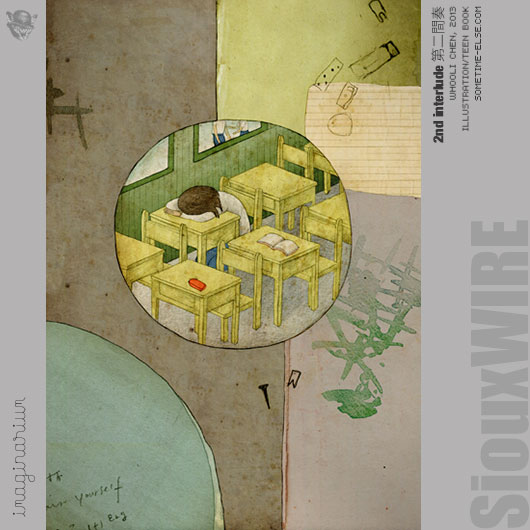
INTERVIEW: Chen Whooli


On first seeing Whooli Chen's illustrations, I was delighted by her unique interpretations of the subject matter and organic, surreal style. Based in Taiwan, she has a MA degree in illustration field from University of the Arts London and has worked on a number of books, newspapers, and magazines.

Whooli very kindly took time to answer a few of my questions.


Who are you and what do you do?
I’m a freelance illustrator based in Taiwan. I do editorial illustrations for newspapers, magazines, graphic books, and collaborations with a variety of companies in different fields. I also run a studio with my sister.

Your work are reminiscent of folk tales and children's stories. Would you agree with this and what stories have influenced you?
I do like old-time atmosphere, and also trying to take that as a key visual element in my works. I love literature.  Dream of the Red Chamber, an 18th century Chinese novel, is my latest amusement.  Angela Carter’s quirky stories are always fascinating.


Would you explain the concept behind "The Travelling Project" and "The Diary Project"?
Don’t have much concept behind “the travelling project” really. It’s created when I was in London. Although stay there as a student, I always felt like as tourist. So detached from the locals, seemed the days they’re living can be called a day-to-day life, rather than mine. So what we did, my sister and I, was travelling  and exploring the city. The drawings were send out as postcards, described our journey in London.

“The diary project” is a collaborative project with 集日美工(365days.tw). A cover of 365days calendar notebook and entitled “Room of one’s own”. It’s about collecting, people collect leaves, coral specimen pieces, oak fruits, and childhood hair. Treasure them as they reflect our memories. Until rooms are filled. However, with a filled room, we ourselves still dream about being collected, in someone else’s room.


For your editorial illustrations, you have a unique approach to the subject matter. How do you develop these sorts of illustrations and how much freedom are you given?
Editorial illustrations are for magazines and newspapers. After I got a story form editor, I’ll read it thoroughly   then pick the elements out and give the connection between them, story becomes the frame, and hopefully the relation of every little elements can be depicted and reveal the story, therefore illustrate the frame. I am always trying to find a new approach to every story, a new way to construct, to express, or, even an interpretation. As long as the illustration meets the gist of the story, and understandable. I’ve been completely trusted.


How did you develop your skills and what would you say has been the most important thing you've learned in your career?
I studied fine art before I got a MA degree in illustration. There is a fine line between these two disciplines, in training and in the way of expression as well.

When you were in school, especially in Taiwan, every assignment was about to improve your technical skills, and your capabilities to manage all the tools. However, when you are twenty, that was the whole thing you’d sniff at, ... conventional, academic,... If, there were any heritage left, I’d say, it has made “the career” much approachable.


What is the significance of animals in your work? You have mentioned missing a fox that you knew in London.
“Whooli” is the pronunciation of fox in Chinese. I was living in the top floor of a 19th century yellow brick house in west London  there was a red fox living across the street, sometimes I can see her sunbathing in neighbour’s back yard. I miss her, so take Whooli as a pseudonym name, it’s kind of remind me the London times.

What materials do you use to create your illustrations and why do you use these in particular?
Hand drawing, and digital colouring. Digital can be adjusted  easily, which save some labour for low-paid commissions...


What have been some of your favourite responses to your work?
Poetic, is one of the compliments I enjoy most.

Do you have any favourites or pieces of special importance among the work you've done?
Favourite is always the next one. And, I think my MA graduated project “Land and Tales ” plays the role as a small milestone.


Who is your favourite musician, film maker, painter and writer and why?
Marc Chagall, Rene Magritte, Egon Schiele, Francesca Woodman, Sarah Moon, Sophie Calle, Angela Carter. They are all inspiring and have a remarkable vision in their field of art.

What are you currently working on and what future projects do you have planned?
I’m in the half way of a children’s book. And, some secret projects under the name of our studio, hopefully will come true this year.

Thank you, Whooli.


Links:

Thursday, 23 May 2013

INTERVIEW: Valentina Talijan


Valentina Talijan was born in Belgrade, Serbia in 1989. She is currently studying painting in Novi Sad, Serbia on Academy of Arts, and will graduate in June this year. She has participated in a dozen group exhibitions in Serbia as well as one in France and South Korea. I discovered her work on Behance and really enjoy her Kolaž series.

Featuring art students will become a regular part of the WIRE and Valentina was very charming and down-to-earth in her replies to my questions despite the language hurdle.


What triggers the creation process in you and how does it develop to its completed form?
Before I start to work I intend to collect as much information as I can and to find answers to as many questions about the theme I choose to deal with. I like to think about the wind, or about the immensity of the Universe (thanks a lot Doctor Who). I would say that thinking about constant movement is what triggers creation process in me (related with works presented here). Sometimes the process consists of months of just thinking about something and a few days of materializing the idea. I believe that the art doesn’t just pop out, there is work that every artist must do; if you do not do the work everyone will know it. Regarding this particular series of collages, I spent most of the time dealing with materials that I used.

Outside the media in which you work, what arts appeal to you and/or inspire you and why?
Definitely new media and performance art. New media art because art should represent the time in which it is created and we live in a time of technology. Plus their work is mainly awesome. Because I am in a phase of thinking about the artist as a piece of art, I find it very interesting. The relationship between the audience and the artist as part of the art work (or one of the objects in composition of the space involved in performance) reminds me of Baroque art spaces and the active energy in them.


How would you describe contemporary art in Serbia at the moment?
There are a few who shine. I would say it like that, because I think that my country has too many artists proportionally to its population. Personally I have a lot of respect for the work of Simonida Rajčević and a group of artists called Third Belgrade.

Why make art? 
Honestly I don’t know how to answer that question. I think that I will never find the answer and that’s a good thing. Art is not the only thing that I do, but all of the other things I do are art related.

What are your aspirations in terms of your art?
I am planning to stay for a while on the project on which I am working right now. I think that I have barely made any steps from the start and that there is still a lot of work to do; and I am currently obsessed with the facts about constant motion, I just can’t help it.


Links:
Valentina Talijan


Saturday, 18 May 2013

SiouxWIRE Update


Some of you may have been wondering why there haven't been as many posts this week and what is happening. First, there are more than 50 interviews outstanding at the moment. This is terrific news but I have a policy of not pushing people to reply quickly giving them no time constraint or deadline as this tend to deliver the best, most considered replies. Second, I have forgone publishing everything I've found as my Tumblr and Pinterest accounts do this very well. Essentially, I've reserved the WIRE for interviews and longer posts.

I am so eager to share with you the incredible line up of people who will be featured in the coming months. I've interviewed talented artists from every corner of the world across a wide array of mediums including those just starting their career to the established and renowned. With the help of noble interpreters and unprecedented support from galleries, things are going very well. It won't be long before things hit critical mass and the interviews can run to the circadian rhythm I would like.

As a side note, the layout of the site is still undergoing some updates and in the mid term some very big changes are in the works. Older interviews and posts will also be updated with new material and larger images. So bear with me while SiouxWIRE ramps up to something wonderful and thank you all for your support.

all the best,
Siouxfire


*image above from The U.S. National Archives with modification


Thursday, 16 May 2013

Amy Bennett's AT THE LAKE


Amy Bennett's At The Lake reminds me of Julio Cortazar's Blow Up. I feel as if I'm looking through a lens and the closer I look, the clearer it becomes that all is not well at the lake. With a style of painting that gives her scene the look of a tilt-shift photograph with people looking vaguely like miniature figures, it has the effect of making each individual look so incredibly isolated. Even in groups (as above), individual isolation seems to be magnified as the Spartan landscape intensifies the odd focus on people despite their diminutive size.

Aside from isolation, the titles imply uncertainty and menace forcing you to investigate further. It's an odd experience seeing her paintings. At first glance or from a distance, they seem vaguely akin to Edward Hopper but perhaps with even brighter colours and optimism. A step closer and the eye senses something isn't right. What scale is this? Are those people or toys? Even closer observation raises more questions and looking for clues in the titles adds to the mystery.

Take the image below as an example. Is the man helping the woman from the lake? Has she passed out? Why isn't she wet? Oh, there's a boat... The title is "Into the Woods". What happened before? What will happen next? I love how these paintings play on our expectations with double edged narratives enhanced so incredibly by Amy Bennett's unusual style.


"Working with common themes such as transition, aging, isolation, and loss, I am interested in the fragility of relationships and people’s awkwardness in trying to coexist and relate to one another. To that end I create miniature 3D models to serve as evolving still lifes from which I paint detailed narrative paintings. Using cardboard, foam, wood, paint, glue, and model railroad miniatures, I construct various fictional, scale models. Recent models have included a neighborhood, lake, theater, doctor’s office, church, and numerous domestic interiors. The models become a stage on which I develop narratives. They offer me complete control over lighting, composition, and vantage point to achieve a certain dramatic effect."


"While working with tiny pieces that often slip frustratingly from my fingers, I am reminded of the delicacy and vulnerability of the world I am creating, and this summons empathy for my subject. The clumsy inadequacies of miniatures help me to convey a sense of artifice and distance.  I try to paint the scenes in a way that feels like a believable world, but an alternate, fabricated world."


"The paintings are glimpses of a scene or fragments of a narrative. Similar to a memory, they are fictional constructions of significant moments meant to elicit specific feelings and to provoke the viewer to consider the moment before or after the one presented in the painting. I am interested in storytelling over time through repeated depictions of the same house or car or person, seasonal changes, and shifting vantage points. Like the disturbing difficulty of trying to put rolls of film in order several years after the pictures have been taken, my aim is for the collective images to suggest a known past that is just beyond reach."


"Throughout 2010 and 2011, I created a mosaic with fabricator Franz Meyer of Munich for MTA’s Arts for Transit. Installation of the project, “Heydays” was recently completed in the 86th St./4th Ave. R Line Subway Station in Bay Ridge, Brooklyn. This past summer my work was also featured in “Otherworldly”, a show at The Museum of Arts and Design in New York City. Recent awards include The American Academy of Arts & Letters The Rosenthal Family Foundation Award, a NYFA Fellowship in Painting, and a residency at The Marie Walsh Sharpe Studio Program. Sore Spots, a show of new paintings, monotypes, and sculpture, is currently on view at Galleri Magnus Karlsson in Stockholm."


Links:
Amy Bennett
Amy Bennett (Richard Heller Gallery)
Amy Bennett (The Harlow)

Tuesday, 14 May 2013

INTERVIEW: Moose Allain


I have followed Moose Allain for a long time on Twitter and enjoying his off kilter sense of humour without realising that he also creates stuff as well. In selecting the above image as the vanguard of his work, I wanted to share something with the text-based humour that I've come to enjoy. You will not see a better use of the phrases "Flenching Plate", "Perspiration Loons" or "Drainage Runnels".

His creations are refreshing, organic reflections of his plays on language via Twitter. Though it feels a little strange being more than 140 characters in length, Moose took time out of his busy Tweeting schedule to answer a few of my questions and provide a few good laughs and insights...


I first got to know you when we exchanged some witty banter. You were something of an anomaly on my timeline like a kid at a party quietly speaking in tongues in the corner but in fact probably making more sense than anyone else. How has Twitter influenced your artwork?

Ha! That's a nice, flattering description. I will accept your compliment because it reflects something I've always tried to do – not just on Twitter, but in my life generally - which is to be original. Now Twitter is completely hardwired into my mind, and I think that's mainly because for me it's a creative channel. I think people use Twitter in all sorts of ways, but for me its shape is usually: “output/ a bit of replying”. In other words, I seldom have time to read the tweets of the people I've chosen to follow. Other times I would describe my Twitter activity as: “hosting”. This is sometimes in the form of a hashtag/RT process or asking a question e.g. What is your local word for an alley way? And RTing the replies. Sometimes I improvise a story in tweets. That tends to divide an audience – some people love them, but I can usually expect to lose about 30 followers when I do it. So I use Twitter in varying ways, various techniques, ultimately trying to engage an audience, entertain and be original.


My main interest in Twitter is language & the play of language. I think I've, fairly successfully, managed to integrate Twitter into my 'practice' (not a term I like). I think it means I've become a lot more than a visual artist, which is great because I'm just as interested in words as I am in images. I think some of the artists I like most, the word 'art' doesn't really cover it. They just do interesting stuff with their lives, use art as a way of exploring the world – I'm thinking of people like Adam Chodzko or Sophie Calle – 'art', whatever that is, is a sort of by-product of these processes. Well, that aggrandises my work far too much, but in the end it's about connecting to people en masse as well as individually. Twitter is perfect for that, it has opened me up to an audience that you then have to perform for. It has not only opened me up to an audience, but to all sorts of collaborations. I could go on about this for ages but I'll stop there.


Recently @40elephantsmob had a selection of her tweets turned into the brilliant animation Mummy Needs Gin. Have you considered turning your tweets into something more? (film, book, etc) 

Yes. In short. I have made little books of my tweet stories a couple of years ago. I don't have the patience for animation, but I'd be happy for someone else to make them! I work with a local film company, Meat Bingo, here in Devon – we're about to start on our third project. We are lucky to have the writer David Quantick as a key member – he's from Exmouth, and Twitter has got us together. Anyway, there's potential there. I'd love to do a book of them, illustrate them myself… But I have so many projects in my head I know I'll probably never get round to.

"...I was a child who didn't want to be like other people. I suffer from reverse peer group pressure."

Who is Moose? Where did he come from? What makes Moose tick? How would Moose introduce himself to a stranger? 

Oh goodness, I don't know! I don't really like thinking about myself really. I am extremely grateful that I've got to a stage in my life where I can describe myself as an artist. So many interesting things are coming out of it, all sorts of projects, it feels like I'm at the beginning of things, which is so exciting. Before this I was a disillusioned architect. That's where I came from most recently. Looking at my adult life, it was a lot of drifting about never really being happy because I really wanted to be an artist but didn't think it was possible. Going back to your first question, I was a child who didn't want to be like other people. I suffer from reverse peer group pressure. That's stayed with me.


How much planning goes into your drawings and how much comes about organically as you work?

It's nearly all organic. I seldom pre-draw, I just have an idea and run with it. It's very liberating.


Your work on Stephen Fry's 100 Greatest Gadgets have integrated "Drainage Runnels" and "Perspiration Loons" into my vocabulary. How did you approach this project and how much of a collaboration was it with Mr. Fry?

Actually this was a quick job, which is why I resorted to collage. I had no contact with Mr Fry, simply a sentence for each of the 3 ideas which I had to illustrate. I had used the technique before for a range of cards, so I thought it would look just right and reflect his gentlemanly subversive character. The language was an important part of it, for me, although I'm not sure how much it came across on the TV. It was great fun to do.


What instigated the creation of We Meet in the Shadows and how did it develop?

A couple of years ago I decided I wanted to work bigger and with colour. Previously I'd been working tiny on my desktop so this was an attempt to loosen up a bit. It also reflected a return to architecture, in so far as I could dream up places again. The technique is to put on a wash of background colour – it's all acrylic paint and inks – then drop ink onto it and move it around with bits of plastic, straight edges, starting to form shapes. Next stage is to pick out black lines with the same straight edges, I also use a little wheel. After that I go in with the dipping pen and add more architectural detail. The final stage is to add figures and find a story in there somewhere, a theme. So the subject ends up being a response. This is very much the organic process I mentioned in the last question – I like to react.

"...I am trying to be entertaining and, this can sound trite but I don't believe it is, my work is also about bringing joy"

How would you describe your subject matter or the content of your work? 

The subject matter, well it's mostly stuff that's in my head. Be that visual art or writing or the two combined. In other words, I'm not an observational artist. But I am trying to be entertaining and, this can sound trite but I don't believe it is, my work is also about bringing joy. I think people really respond to that. I hate being asked what my work's like partly because it's not really like other people's work and also because it's very varied. I usually say “It's more like illustration, quite graphic and cartoony, mostly from my imagination”. That sort of covers it, but that really only describes the visual art, which isn't the whole of it by any means.


What was the last artwork to impress you and why? (painting, illustration, film, music, etc) 

The last to impress me. That makes it a bit easier. I've just downloaded the recent ATOM TM album and there's a couple of tracks on there that I can't get enough of. A couple of days ago I went to a talk at the Royal Albert Memorial Museum in Exeter about the BP Portrait Award exhibition which is on there currently. It was fascinating because I am interested in painting, but the winning portrait is amazing and I had quite an emotional response to it. It's called Auntie by Aleah Chapin.

It's a painting of a smile and it smiles at you in a most incredible way – to the extent that you hardly noticed she is an naked older woman.

"...there are artists earning millions from being up themselves, so they've a right to take themselves seriously I suppose."

Do you think the art world takes itself too seriously sometimes? 

The art world… it's so big it's about the same size as the real world, so it's hard to generalise. Some of it is shockingly up itself. On the other hand there are artists earning millions from being up themselves, so they've a right to take themselves seriously I suppose. You look at people like Damien Hirst and think it must be odd to make art that is really only ever about money now. He's like King Midas. To be honest I don't really see myself as part of an art world as my main interactions are with people who aren't in it, if you know what I mean. Just people who like my work or want to commission something or just tell me they like it. I didn't go to art school so I don't feel burdened by the need to explain myself. Artist's statements, by those who have been through the art system, are hilariously pretentious, homogeneous and meaningless. So, to be enjoyed at that level at least.


Are you working on anything at the moment or have any new projects in the pipeline? 

Lots of work comes about via Twitter these days. All sorts of interesting propositions. I'm just about to finish working on a project for Tate Britain – a family guide leaflet for their upcoming Lowry exhibition. It was a great privilege to be asked to contribute. I have various writing projects in the pipeline which may or may not come off. A new film to collaborate on, more walls to draw on, a big commission which desperately needs my attention, more fun to be had on Twitter and with Vine and Instagram, Oh bloody hell I've got so much to do I'd better get on

Thank you, Moose.


Links:
World of Moose
Moose Allain (Twitter)


Related Posts Plugin for WordPress, Blogger...