Showing posts with label interview. Show all posts

Friday, 24 May 2013

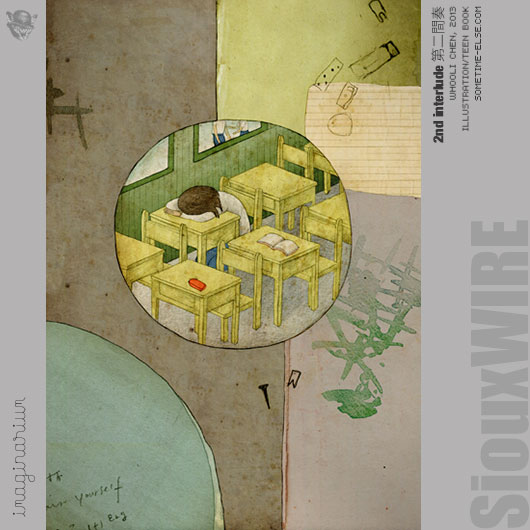
INTERVIEW: Chen Whooli


On first seeing Whooli Chen's illustrations, I was delighted by her unique interpretations of the subject matter and organic, surreal style. Based in Taiwan, she has a MA degree in illustration field from University of the Arts London and has worked on a number of books, newspapers, and magazines.

Whooli very kindly took time to answer a few of my questions.


Who are you and what do you do?
I’m a freelance illustrator based in Taiwan. I do editorial illustrations for newspapers, magazines, graphic books, and collaborations with a variety of companies in different fields. I also run a studio with my sister.

Your work are reminiscent of folk tales and children's stories. Would you agree with this and what stories have influenced you?
I do like old-time atmosphere, and also trying to take that as a key visual element in my works. I love literature.  Dream of the Red Chamber, an 18th century Chinese novel, is my latest amusement.  Angela Carter’s quirky stories are always fascinating.


Would you explain the concept behind "The Travelling Project" and "The Diary Project"?
Don’t have much concept behind “the travelling project” really. It’s created when I was in London. Although stay there as a student, I always felt like as tourist. So detached from the locals, seemed the days they’re living can be called a day-to-day life, rather than mine. So what we did, my sister and I, was travelling  and exploring the city. The drawings were send out as postcards, described our journey in London.

“The diary project” is a collaborative project with 集日美工(365days.tw). A cover of 365days calendar notebook and entitled “Room of one’s own”. It’s about collecting, people collect leaves, coral specimen pieces, oak fruits, and childhood hair. Treasure them as they reflect our memories. Until rooms are filled. However, with a filled room, we ourselves still dream about being collected, in someone else’s room.


For your editorial illustrations, you have a unique approach to the subject matter. How do you develop these sorts of illustrations and how much freedom are you given?
Editorial illustrations are for magazines and newspapers. After I got a story form editor, I’ll read it thoroughly   then pick the elements out and give the connection between them, story becomes the frame, and hopefully the relation of every little elements can be depicted and reveal the story, therefore illustrate the frame. I am always trying to find a new approach to every story, a new way to construct, to express, or, even an interpretation. As long as the illustration meets the gist of the story, and understandable. I’ve been completely trusted.


How did you develop your skills and what would you say has been the most important thing you've learned in your career?
I studied fine art before I got a MA degree in illustration. There is a fine line between these two disciplines, in training and in the way of expression as well.

When you were in school, especially in Taiwan, every assignment was about to improve your technical skills, and your capabilities to manage all the tools. However, when you are twenty, that was the whole thing you’d sniff at, ... conventional, academic,... If, there were any heritage left, I’d say, it has made “the career” much approachable.


What is the significance of animals in your work? You have mentioned missing a fox that you knew in London.
“Whooli” is the pronunciation of fox in Chinese. I was living in the top floor of a 19th century yellow brick house in west London  there was a red fox living across the street, sometimes I can see her sunbathing in neighbour’s back yard. I miss her, so take Whooli as a pseudonym name, it’s kind of remind me the London times.

What materials do you use to create your illustrations and why do you use these in particular?
Hand drawing, and digital colouring. Digital can be adjusted  easily, which save some labour for low-paid commissions...


What have been some of your favourite responses to your work?
Poetic, is one of the compliments I enjoy most.

Do you have any favourites or pieces of special importance among the work you've done?
Favourite is always the next one. And, I think my MA graduated project “Land and Tales ” plays the role as a small milestone.


Who is your favourite musician, film maker, painter and writer and why?
Marc Chagall, Rene Magritte, Egon Schiele, Francesca Woodman, Sarah Moon, Sophie Calle, Angela Carter. They are all inspiring and have a remarkable vision in their field of art.

What are you currently working on and what future projects do you have planned?
I’m in the half way of a children’s book. And, some secret projects under the name of our studio, hopefully will come true this year.

Thank you, Whooli.


Links:

Tuesday, 14 May 2013

INTERVIEW: Moose Allain


I have followed Moose Allain for a long time on Twitter and enjoying his off kilter sense of humour without realising that he also creates stuff as well. In selecting the above image as the vanguard of his work, I wanted to share something with the text-based humour that I've come to enjoy. You will not see a better use of the phrases "Flenching Plate", "Perspiration Loons" or "Drainage Runnels".

His creations are refreshing, organic reflections of his plays on language via Twitter. Though it feels a little strange being more than 140 characters in length, Moose took time out of his busy Tweeting schedule to answer a few of my questions and provide a few good laughs and insights...


I first got to know you when we exchanged some witty banter. You were something of an anomaly on my timeline like a kid at a party quietly speaking in tongues in the corner but in fact probably making more sense than anyone else. How has Twitter influenced your artwork?

Ha! That's a nice, flattering description. I will accept your compliment because it reflects something I've always tried to do – not just on Twitter, but in my life generally - which is to be original. Now Twitter is completely hardwired into my mind, and I think that's mainly because for me it's a creative channel. I think people use Twitter in all sorts of ways, but for me its shape is usually: “output/ a bit of replying”. In other words, I seldom have time to read the tweets of the people I've chosen to follow. Other times I would describe my Twitter activity as: “hosting”. This is sometimes in the form of a hashtag/RT process or asking a question e.g. What is your local word for an alley way? And RTing the replies. Sometimes I improvise a story in tweets. That tends to divide an audience – some people love them, but I can usually expect to lose about 30 followers when I do it. So I use Twitter in varying ways, various techniques, ultimately trying to engage an audience, entertain and be original.


My main interest in Twitter is language & the play of language. I think I've, fairly successfully, managed to integrate Twitter into my 'practice' (not a term I like). I think it means I've become a lot more than a visual artist, which is great because I'm just as interested in words as I am in images. I think some of the artists I like most, the word 'art' doesn't really cover it. They just do interesting stuff with their lives, use art as a way of exploring the world – I'm thinking of people like Adam Chodzko or Sophie Calle – 'art', whatever that is, is a sort of by-product of these processes. Well, that aggrandises my work far too much, but in the end it's about connecting to people en masse as well as individually. Twitter is perfect for that, it has opened me up to an audience that you then have to perform for. It has not only opened me up to an audience, but to all sorts of collaborations. I could go on about this for ages but I'll stop there.


Recently @40elephantsmob had a selection of her tweets turned into the brilliant animation Mummy Needs Gin. Have you considered turning your tweets into something more? (film, book, etc) 

Yes. In short. I have made little books of my tweet stories a couple of years ago. I don't have the patience for animation, but I'd be happy for someone else to make them! I work with a local film company, Meat Bingo, here in Devon – we're about to start on our third project. We are lucky to have the writer David Quantick as a key member – he's from Exmouth, and Twitter has got us together. Anyway, there's potential there. I'd love to do a book of them, illustrate them myself… But I have so many projects in my head I know I'll probably never get round to.

"...I was a child who didn't want to be like other people. I suffer from reverse peer group pressure."

Who is Moose? Where did he come from? What makes Moose tick? How would Moose introduce himself to a stranger? 

Oh goodness, I don't know! I don't really like thinking about myself really. I am extremely grateful that I've got to a stage in my life where I can describe myself as an artist. So many interesting things are coming out of it, all sorts of projects, it feels like I'm at the beginning of things, which is so exciting. Before this I was a disillusioned architect. That's where I came from most recently. Looking at my adult life, it was a lot of drifting about never really being happy because I really wanted to be an artist but didn't think it was possible. Going back to your first question, I was a child who didn't want to be like other people. I suffer from reverse peer group pressure. That's stayed with me.


How much planning goes into your drawings and how much comes about organically as you work?

It's nearly all organic. I seldom pre-draw, I just have an idea and run with it. It's very liberating.


Your work on Stephen Fry's 100 Greatest Gadgets have integrated "Drainage Runnels" and "Perspiration Loons" into my vocabulary. How did you approach this project and how much of a collaboration was it with Mr. Fry?

Actually this was a quick job, which is why I resorted to collage. I had no contact with Mr Fry, simply a sentence for each of the 3 ideas which I had to illustrate. I had used the technique before for a range of cards, so I thought it would look just right and reflect his gentlemanly subversive character. The language was an important part of it, for me, although I'm not sure how much it came across on the TV. It was great fun to do.


What instigated the creation of We Meet in the Shadows and how did it develop?

A couple of years ago I decided I wanted to work bigger and with colour. Previously I'd been working tiny on my desktop so this was an attempt to loosen up a bit. It also reflected a return to architecture, in so far as I could dream up places again. The technique is to put on a wash of background colour – it's all acrylic paint and inks – then drop ink onto it and move it around with bits of plastic, straight edges, starting to form shapes. Next stage is to pick out black lines with the same straight edges, I also use a little wheel. After that I go in with the dipping pen and add more architectural detail. The final stage is to add figures and find a story in there somewhere, a theme. So the subject ends up being a response. This is very much the organic process I mentioned in the last question – I like to react.

"...I am trying to be entertaining and, this can sound trite but I don't believe it is, my work is also about bringing joy"

How would you describe your subject matter or the content of your work? 

The subject matter, well it's mostly stuff that's in my head. Be that visual art or writing or the two combined. In other words, I'm not an observational artist. But I am trying to be entertaining and, this can sound trite but I don't believe it is, my work is also about bringing joy. I think people really respond to that. I hate being asked what my work's like partly because it's not really like other people's work and also because it's very varied. I usually say “It's more like illustration, quite graphic and cartoony, mostly from my imagination”. That sort of covers it, but that really only describes the visual art, which isn't the whole of it by any means.


What was the last artwork to impress you and why? (painting, illustration, film, music, etc) 

The last to impress me. That makes it a bit easier. I've just downloaded the recent ATOM TM album and there's a couple of tracks on there that I can't get enough of. A couple of days ago I went to a talk at the Royal Albert Memorial Museum in Exeter about the BP Portrait Award exhibition which is on there currently. It was fascinating because I am interested in painting, but the winning portrait is amazing and I had quite an emotional response to it. It's called Auntie by Aleah Chapin.

It's a painting of a smile and it smiles at you in a most incredible way – to the extent that you hardly noticed she is an naked older woman.

"...there are artists earning millions from being up themselves, so they've a right to take themselves seriously I suppose."

Do you think the art world takes itself too seriously sometimes? 

The art world… it's so big it's about the same size as the real world, so it's hard to generalise. Some of it is shockingly up itself. On the other hand there are artists earning millions from being up themselves, so they've a right to take themselves seriously I suppose. You look at people like Damien Hirst and think it must be odd to make art that is really only ever about money now. He's like King Midas. To be honest I don't really see myself as part of an art world as my main interactions are with people who aren't in it, if you know what I mean. Just people who like my work or want to commission something or just tell me they like it. I didn't go to art school so I don't feel burdened by the need to explain myself. Artist's statements, by those who have been through the art system, are hilariously pretentious, homogeneous and meaningless. So, to be enjoyed at that level at least.


Are you working on anything at the moment or have any new projects in the pipeline? 

Lots of work comes about via Twitter these days. All sorts of interesting propositions. I'm just about to finish working on a project for Tate Britain – a family guide leaflet for their upcoming Lowry exhibition. It was a great privilege to be asked to contribute. I have various writing projects in the pipeline which may or may not come off. A new film to collaborate on, more walls to draw on, a big commission which desperately needs my attention, more fun to be had on Twitter and with Vine and Instagram, Oh bloody hell I've got so much to do I'd better get on

Thank you, Moose.


Links:
World of Moose
Moose Allain (Twitter)


Monday, 13 May 2013

INTERVIEW: Magdalena Bors


Magdalena Bors' surreal and fantastical works tell tales of creation, nature and hidden places. Her labour intensive environments seem to harken back to her roots in architecture and conjure up reflections of natural environments from household materials.

While preparing for her exhibition at Galleri Image in Denmark, she took time to answer my questions and was very sportingly, the first to submit to a "pictaview" style question for which I am delighted with the response.

First, here is her artist statement:


"My practice to date has predominantly explored the idea of the sublime in the everyday. I have done this by constructing, then photographing fantastical landscapes in domestic spaces. Our connection with the natural world is the driving force behind my work. I am fascinated by the simultaneous strength and fragility of this connection as we go about our lives, spending most of our time within the confines of the small compartments we call home.​

The images in Homelands can be seen as snapshots of daydreams conjured in a moment of distraction while performing everyday tasks. While the landscapes are staged in familiar spaces and use familiar objects, emotive, sometimes dramatic lighting leaves room for ambiguity about whether the scenes are ‘real’ or imagined. Homelands was born out of my own desire to be in, and to photograph the kind of landscapes that were out of my reach in the real world.

The characters in my latest series of images The Seventh Day have been overtaken by a seemingly uncontrollable compulsion to create complex environments from materials found in the domestic realm. The processes undertaken to create the landscapes are extremely labour intensive and involve repetitive, painstaking tasks. Food scraps and remnants of materials seen in the images allude to the passing of time and the physicality of the processes involved. The resulting scenes resemble familiar, sometimes iconic natural landscapes.​"


You studied Architecture in Brisbane before studying photography; do you apply any of this architectural background to your current work? And did it help in any way to develop your photography and if so, how?

I don’t apply my architectural background consciously, but I’m sure many of the decisions I make in a design sense stem from what I learnt during that time. Looking back, I did spend a lot of my time as an architecture student producing meticulous models of my designs… The designs themselves were quite average, but the models were impressive! Architecture definitely did develop my passion for photography.  It became my preferred medium for documenting everything to do with a potential project, from site and material studies, to macro photographs of those carefully constructed models. I was obsessed with recording light. One time, I stayed at a site for 24 hours to record how light fell on a wall every 15 minutes. It was also my introduction to a darkroom, where I spent many, many hours… So really, I guess Architecture more or less helped me find my medium – construction and photography. It also taught me a great deal about patience, perseverance and problem solving.


What would you say is the significance of "hidden worlds" to your work?

Hidden worlds and hidden spaces fascinate and excite me. ‘Homelands’ explores hidden worlds in both the physical sense (behind cupboards, under tables), and hidden in the psychological sense (existing only in the imagination). I’m intrigued by the duality of our public/private selves, and the level of privacy that our homes afford us, particularly in inner city areas with dense populations. Isn’t it extraordinary that you can live somewhere for years, but have no idea what goes on just a couple of meters either side of you? The scenes of ‘The Seventh Day’ are portraits of very private moments. It is only through the voyeuristic eye of the camera that we are given the opportunity to view them.


What is it about German Romantic painter Caspar David Friedrich that attracts you? And do you have a favourite among his work?

I’m drawn to Caspar David Friedrich’s deeply moving depictions of ‘moments of sublimity’, something I aspire to portray in my own images. I think there is a similarity in the attitude of contemporary society and that of the society of the late 18th and early 19th centuries, which is perhaps why there is an apparent resurgence in the popularity of romantic art. There seems to be a growing undercurrent of disillusionment with materialistic society, a renewed interest in spirituality and a need to re-connect with the natural world.

"Some of the sets in ‘The Seventh Day’ actually took months to make..."

It’s difficult to choose, but I would have to say ‘Two Men Contemplating the Moon’ is probably the image of his that affects me the most. Do you remember as a child, looking at the moon and standing still enough and for long enough to see it move? I recall it being quite a ‘magical’ moment, but it wasn’t until I was quite a bit older and understood the mechanics of the universe better, that the same exercise offered quite a profound, humbling experience. When I occasionally remember to pause and do this now, it still takes my breath away. To me, this is what the two men in this image are experiencing; a moment of realisation of the magnificence they are witnessing, as well as their relative insignificance to it.


You've described the process of developing props as taking several weeks to complete and two days to set up and shoot; is there a particular reason you only produce a single image from each concept?

Some of the sets in ‘The Seventh Day’ actually took months to make, but the length of time it takes me to make them is beside the point. Even if an image took me years to construct, there would only be one resulting photograph. If I ever felt the need to take ten photographs of one set, that would be the time to move the set into a gallery and call it an installation. I think my images would significantly loose impact if I were to photograph several versions of one concept. Why water down a good idea? I have little interest in producing ‘large’ bodies of work in a commercial sense either, which I guess is sometimes an expectation of photographic artists. That’s not to say I won’t ever produce larger numbers of photographs, but just not without good reason.

"I wouldn’t completely rule out doing installations in the future..."

What was the last revelation you've had in regard to your work?

I think I’m too close to my work at the moment to have any significant revelations… Maybe that is a small revelation in itself. If I were less involved in the ‘making’ process, perhaps I would create images that were stronger conceptually.


Aside from photography, what other arts do you practice and have you ever considered making any of your works into installations?

It’s a question I get asked a lot, but I just don’t think my current concepts work as installations. The context of these images is so important, not to mention the meticulous lighting, posing of subjects and the precise expression during that critical 1/60th of a second. A few years ago, a gentleman contacted me to enquire about purchasing ‘Woodland Scene’, but as I proceeded to give him print size information, he interrupted to explain that he wanted to purchase the ‘Woodland Scene’. Of course I had to explain the elements of the set and the moment was long gone, but to this day I am fascinated with this desire to possess what was represented in a physical sense. I wouldn’t completely rule out doing installations in the future, but I think it would involve something site specific and unlikely to be in a traditional gallery space.


Are you working or developing anything new at the moment?

I’m stepping outside the domestic realm for my new body of work, which I’ll begin working on later this year.


PICTAVIEWBelow are three images. Please comment on them in any way you see fit. You may comment on each individually or as a group and your reply may be anything from a description of what they mean to you to a fictional narrative or poem. There are no rules except that which you put down should in some way have been instigated by one or more of these images. It isn't a critique of the image but rather a free form reply/reaction.


Ashes, ashes, ashes, orange. I have an early childhood memory of being on a rural property with some older kids; we were playing with the smouldering remains of a large bonfire. There were no adults present, and although my memory of the circumstances surrounding the event are vague, I distinctly remember an exhilarating feeling of rebellion as we poked and prodded the dying fire, daring it to come to life again. I also vividly remember the cave-like little scene created by the glowing embers, and the hissing sounds as one of the older kids rolled an orange into the ‘cave’, followed by the incredible smell of slowly burning orange. Since then I’ve always associated ashes with oranges.


Thank you, Magdalena.


Links:
Magdalena Bors
Magdalena Bors (Facebook)
Magdalena Bors Interview (Blanket)


Sunday, 12 May 2013

INTERVIEW: Reed Young


I discovered Reed Young's work through his series Las Pajas and the Luck Haitians. The series works extremely well as a series of portraits in their own right but as a documentary series along with the accompanying text, it is sublime. My personal favourite is Chi Chi (above). His works cover broad and eclectic subjects. You can see more of Las Pajas and the Luck Haitians and other series on his site and blog.

After attending photography school in 2002, graduating from Brooks Institute in 2005, and a yearlong residency at FABRICA, the Communication Research Center of Benetton Group in Treviso, Italy, Reed has done work for a variety of publications including National Geographic, TIME magazine, and The Guardian. His works span a wide range of subject matter, locales and working conditions. He is currently based in New York.

Mr. Young took his time out to answer my questions which you can read below.

First, here is Reed's statement on Las Pajas and the Luck Haitians...


"Lost in the vast sugarcane fields of the Dominican Republic, there are hundreds of small villages called Bateys. These underdeveloped towns were established in the beginning of the 20th Century to house migrant Haitian workers during the sugarcane season.
The Bateys were intended to be seasonal towns. But in the last 40 years, the Dominican Republic has become a symbol of hope and prosperity for the Haitians. Because of this, more and more Haitians have discontinued going back to Haiti after the season and have started families in the Bateys.
In theory, this sounds ideal. But the infrastructure for a permanent population remains unmet in the Bateys. The schools have little to no funding; there’s no running water or plumbing; and trash collection is obsolete. Another problem plaguing these small communities is the lack of legal documentation of citizenship. Without the basic rights as a citizen, most of these people are denied education and healthcare. This has created significant social status issues, which will only improve with the help of humanitarian organizations.
At the time I took these pictures, my friend Rachel Gottesman lived in this small Batey called Las Pajas. Rachel invited me to stay with her for a few days, and it was an eye-opening, unbelievable experience. Even though the problems plaguing the Bateys are similar, each person had a unique story to tell.
In the end, I was the biggest beneficiary of all. I was honored to learn about their lives. Despite having nothing but each other, they’re more content than most people I meet in the more developed world. I also discovered that money alone isn’t the solution to helping impoverished people. What they need more is education, healthcare and correct nutrition.
I was struck by how these Haitian people view themselves as extraordinarily lucky compared with their families back home. Although the conditions of the Bateys are deplorable, they’re nothing compared to those that exist in Haiti where the current food crisis affects 60 percent of the country’s people.
Who would think that people with no education, no access to healthcare and terrible sanitary conditions would consider themselves lucky? These are the lucky Haitians."


In your series Las Pajas and the Lucky Haitians, you seem to have made a strong connection with your subjects. Would you outline how you approached this series and what you feel made it a unique experience from a photographic perspective?

Most of my personal work consists of a going to a place and finding complete strangers to help me tell a story. It's much more difficult without having a contact within the community. I was fortunate to have a close friend living in Las Pajas and this was a huge help in gaining immediate trust with my subjects. When I arrived I realized that the residents were far more impoverished than I could have imagined.  Most of the stories I see from developing countries have a sad, empathetic approach. So I made an immediate decision to portray these people as the strong and proud people they are—and I think that's what makes this story unique.

"...they did it with a grace and trust that I rarely get to see."

What would you say have been the biggest risks you've taken in your york both practically and artistically?

The most difficult and rewarding thing I've done in the last few years is consistently committing to personal projects. It's a huge challenge both financially and artistically. It's expensive and always difficult to find an original story that I'm passionate about. It's a big risk to travel to a place without knowing anyone, hoping to leave with a piece of people's lives that will create some kind of narrative. It's a risk that I'm becoming more and more comfortable with, but someday I may come back with nothing.


How has your residency at FABRICA influenced your work?

Fabrica was an incredible opportunity. It allowed me to take time to find my voice and learn from my mistakes. Benetton often takes a social interest approach, and it would be difficult to deny that this had an influence on the subject matter I pursue. Meeting other young artists from all over the world was also an invaluable takeaway.

"...we're at a very interesting turning point in media."

Have any friendships developed between you and your subjects and are there any subjects who linger in your memory?

There are so many people who come to mind, but one family sticks out: A year ago right now I was in El Paso, Texas, doing a story about life in America's safest city, a town that shares a border with one of the world's most dangerous cities: Juarez, Mexico. It was there that I met the Delgado family. They invited us into their home and we spent 4 hours talking at their kitchen table. As breakfast turned to lunch, they told us everything about their lives. When speaking about the things that weren't exactly favorable, they did it with a grace and trust that I rarely get to see. We still had a week to go before leaving and often returned just to hang out and listen to their stories. We've spoken by phone five or six times over the last year. The El Paso story should be out in the next week or so.


Would you describe your typical/preferred kit and your favourite lens to work with and why?

I shoot a Canon 5D mark iii. When I was working at FABRICA my boss called me into his office and said that he had a gift for me. It was a cheap 50mm lens. He said that if I shot with anything other than the 50mm he'd fire me. So for the next year I only shot with that fixed 50mm lens. It taught me to move around to find the best vantage point instead of just zooming in and out. As far as photographic craft goes, this was one of the most important things I ever learned.


Which photographers of your generation have earned your respect/inspired you? And artists in other mediums? 

I love the work of Nadav Kander, Edward Burtynsky, Alec Soth, William Eggleston, Philip Lorca Dicorcia and Stephen Shore.

"I've always been more interested in my subjects and their story..."

How do you approach an assignment with a tight timeframe and big ambitions such as your recent shoot with the Yeah Yeah Yeahs? 

I planned as much as I could beforehand, and then when the time came we had about half the amount of time we were expecting. But for anyone who's ever shot high profile people, half the expected amount of time is still better than usual.


What are your goals as a professional and an artist? Are they the same? Why or why not? 

I've always been more interested in my subjects and their story than the medium of photography. If I had another way to go about meeting these people and documenting their lives, while still making a living, I'd be happy to try it. I love journalism and think we're at a very interesting turning point in media. If things go the right way and quality content prevails, I'd love to begin working on more topical issues. I think we're living in a very exciting time and I hope that journalism takes the path that The New York Times did. It's the success of news outlets like the Huffington Post that really scares me.

Many thanks, Reed.


Links:

Permission for usage of the images in this article kindly granted by Reed Young.

Friday, 10 May 2013

INTERVIEW: Kate MccGwire


There's something intriguing about Kate MccGwire's work that pulls you in and invites contemplation. Many feel like a Borges story given physical form yet they are open to broad interpretation perhaps due to their dual nature. At once, her pieces can be relaxing yet tense. The flow of a piece with beautiful curves also resembles a knot. Another fluid shape is beautiful yet restrained in some way. Yet another looks to be a creature yet there's only a hint of its form. They are static yet full of motion. Some of her works look like liquid in zero gravity, suspended and encased in a jar or cabinet and completely individual like an embodiment of the mortal coil in all its melancholy isolation.

Another outstanding quality to her work is its ability to engage a wide range of people across ages and cultures. The mystery is subtle but compelling and pulls the viewer into the curves and folds for further investigation but no one answer is to be found.

I contacted Kate MccGwire and we arranged a telephone interview. When I phoned, she had just come from the back of a mishap in the set up of a new installation where one of the cabinets cracked. Inwardly, I sighed thinking this would put her in a negative mood but I was soon proved wrong. We managed to cover a lot of ground during the interview and she was good natured and enthusiastic throughout. In fact, one of my regrets is that in text you are unable to hear the smiles that punctuated key points in the interview.


SXF: Is it fair to say you've had a symbiotic life with the river?
KM: Yes, absolutely.
SXF: How has it influenced your work? I think your father was a boat builder?
KM: Yes. I was born on a boat yard in Norfolk. He was sort of an accountant I suppose in London in the textile industry and he moved to Norfolk when he had me, the youngest of four children, to sort of change his lifestyle and embrace what he really wanted to do. He got a job with a boat company so we had a house within the boat yard and we grew up paddling and making things and being by the water the entire time. It was an absolutely idyllic childhood.
"They’re never very specific. I never really want it to look just like one thing."
SXF: And your studio is actually on the water now?
KM: Yes. I got a 20 meter Dutch barge that’s 105 years old. I bought it in 2005 after I finished at the Royal College. I fitted it out and it has a beautiful studio which is about 8 meters long and 4 meters wide and has beautiful natural sunlight all day long. We’re on the south side of a strange little island with no road access on the Thames. So it’s quiet; really, really quiet. There’s no roads nearby and I’m only a half hour from London so I found a pretty perfect little slot really. There are various people on the island here that make things. It’s full of small units. The buildings are also wartime and rather decrepit so it’s one man bands really making light engineering work and joinery and there’s a prosthetic hand maker, boat builders... all sorts of weird things. So whatever you want or need; if I need a piece of steel welded, I can get that done. If I need to get a cabinet made, I can get that done here. So it’s a rather beautiful place really.


SXF: Sounds idyllic. What role would you say colour has in your works? Would you ever consider changing the natural colour of the feathers
KM: No. Absolutely not. I’m celebrating the beauty of the natural thing that people overlook. You see a mallard duck on the river and it looks fairly innocuous and rather dull but when it flies you see this flash of blue and it has I think 6 speculum feathers, blue speculum feathers, but you only see them when they fly. So I’m bringing to the fore things I find miraculous in nature. Those feathers in particular if you turn them over there’s no colour on the opposite side but you turn it back and it’s absolutely iridescent and I don’t understand how that can happen. We couldn’t make it ourselves in such a thin material and in nature, it is there and it is miraculous. And I love the fact that you can get a mallard in the UK and you get a mallard in China and they’ll be almost identical.


SXF: Aside from colour, what other qualities do you recognise in the feathers you work with and how are they important?
KM: Well, I think in engineering they are miraculous in the same way the colour is incredible, in that the bird can actually fly with something that is so lightweight, but so beautifully engineered that they can ruffle their feathers then preen them and reconnect the barbs that reattach each filament together.
SXF: My son will do that picking up a feather brushing them one way then the other to make them like new.
KM: Yes. I was taught actually by a taxidermist how to clean the feathers and you can pick up a pretty dire looking feather and clean it with a series of… sort of like a soapy water initially to get the dirt off it. Then it will look like a bedraggled rat and then you put it in a series of different sands It’s called chinchilla and it’s like a very, very fine sand and you agitate it in the sand and then flick the feather and eventually it all comes back to new. It probably takes five minutes to do each feather so for me it’s not a practical solution within large scale pieces.
"...I’m bringing to the fore things I find miraculous in nature."
SXF: Sounds miraculous.
KM: It is miraculous! Honestly, it will look like something you wouldn't even touch and then you can make it perfect again. I sometimes do that for white pigeon feathers because I haven’t got enough and I get delivered quite a few that are a little bit manky and I can clean them and make them perfect.
SXF: They’re like little gems.
KM:  Yes.


SXF: Some of your works feel like creatures themselves or multiple entities in embrace; is this your intention or do you feel your works are more abstract? They feel like a Moebius strip, you look and think that has two sides but there's actually only one but at the same time that truth doesn't quite settle.
KM: They’re never very specific. I never really want it to look just like one thing. It might resemble a snake or squirming creature but they’ll also resemble the human body and creases and crevices within the human body. I do a lot of life drawing and I’m looking at the armpit creases, the joints between the buttocks and knees. I’m referring to them but I’m trying to be ambiguous with them as well.
SXF: Some of your work feels like a fusion between element and animal, water and bird. Do you feel there is an elemental quality to your work?
KM: Yes, absolutely.
"...now I tend to follow my intuition and I think that is paying off..."

SXF: Is there an element of your work that you feel is missed or misinterpreted?
KM: I think if it’s just described as being “snake like”, they’ve missed the point. When I say that I refer to the body a lot, I believe that you will look at the work and see reflected yourself slightly?
SXF: There’s something recognisable.
KM: That is disquieting because you’re seeing it in a very different way. Also, that the cabinets are so close to the work, to me that’s a sort of suffocation or an entrapment that also I find disquieting.


SXF: From your early work Brood which made use chicken wishbones, your works have had a double edge being both beautiful and yet tinged with a darker side though getting increasingly subtle; is this deliberate?
KM: Yes. I mean certainly with the wishbones as I was collecting those 27,000 wishbones I needed, I was shocked when I found out the birds were hatched and dispatched in only 36 days. So you would think that a chicken might have a lifespan of 6 months or something but it’s just over a month. They were all extremely uniform. So the battery farm chickens are what I used for that and that feeds into the message of the work as well. At the same time I was collecting organic bones not really realising initially that they’d be much different but the organic bones are much stronger, they’re longer, they’re all different colours, they have different shapes and sizes whereas the battery farmed ones are stumpy and white and callowed.
"I also like that you don’t have to know about art to be interested in the work I make."
SXF: Have there been any reactions to your work that surprised  or delighted you or linger in your memory?

KM: I really like it when children have a look at it because they are completely devoid of any coolness. They don’t know anything about art or history or anything and so they have a completely visceral reaction to the work. You see them going round and round the cabinet thinking “I understand this piece but there’s no head, I don’t get it. What’s happening?” So that has been fantastic. I had a piece at Plymouth museum and I saw this group of kids and they just walked around and around the work. And they were looking at each other going “hang on a minute, this doesn’t make sense.” I like that. I also like that you don’t have to know about art to be interested in the work I make.
SXF: Yes, I think that’s part of the brilliance of it; it’s very inclusive.
KM: Yes. I was doing a residency in America and we had various visitors and at the end of the day I was absolutely shattered after having to describe and explain my work and present to people all day long. And then this guy arrived in my studio and I said, “Do you know what? I’m really, really tired. I’d like to know what you think.” He sat down and he was the most eloquent person I could have asked. He just brainstormed about what he saw in the work and it was just amazing. He saw in the work meanings and metaphors and relationships I had never thought about because he was so erudite. So that was incredible and we’ve been in correspondence ever since because he spoke so beautifully about it.
SXF: That’s exciting that you instigated those ideas.
KM: Yes. Yes.


SXF: What was the last important revelation you've had?
KM: Well, I suppose… I’m thinking about scale. I’ve been getting bigger and bigger with the work. I don’t know.
SXF: How would you describe the differences between your early work and your more recent creations?
KM: I think I’m probably trusting in my instinct more and I would absolutely agonise about work in the past whereas now I tend to follow my intuition and I think that is paying off, that I have confidence in what I produce. The weird bit about it is that I don’t necessarily have a very fixed idea of what I’m going to make. I start carving and a form will appear and I’ll stand back at the end of it and think “Oh okay, that’s what it is.” But it’s almost like someone else is doing it. So I carve the element first and then I’ll spend maybe a month feathering  a piece. And that’s a sort of meditative process because all the decision making has gone into the bit where I am carving cause I have to make a decision into how the feathers will lie and how the piece is carved; it’s all set then. Whereas the feathering is more dreamlike and I can think about other things and new works as I’m doing that element of it if that makes any sense?
SXF: Yes. I’ve read before that you consider the next project while working on that stage.
KM: Yes.


SXF: Do you think you would go back to using other materials, we touched on the bones earlier…
KM: I would of course. I’m always looking to develop and I haven’t finished. People say, “Are you going to change from feathers?” And I say, “Yes, I will probably change from feathers eventually but I haven’t finished with what I want to say.”
SXF: The forms have been changing recently, haven’t they?
KM: Yes.
SXF: Previously they were more fluid, like liquid floating in zero gravity but now your work has more points of friction.
KM: Yes.
SXF: How would you describe your relationship to your works.
KM: Well, I have a real problem trying to deliver things. Though I make them and finish them in the studio I don’t like them going, parting from them. It doesn’t feel sad. It just feels like a loss. If I still have them I can still do things to them but if they’re gone, that’s it. So I do find it difficult but I’m having to, because there’s quite a lot of work that is out there now, I have to sort of switch off from that bit.
SXF: Thank you so much for your time, Kate.

Thursday, 9 May 2013

INTERVIEW: Saddo


I was quite excited when I discovered Saddo's work but I reigned in my enthusiasm until after I had learned more about his work (having been let down in the past) yet with every piece of work I found, the same confidence and momentum was there. Disconcerting, fun, and puzzling, his works feel light yet are profound, the colours bright but staid; they're coils of contradiction that unapologetically straddle genres. I love them and I'm more than a little perplexed how he hasn't received even more attention than he already has.

Obviously, I immediately got in touch with him and put a number of questions to him which he answered with confidence, candour and a refreshing lack of ego.


You say in your bio that in your childhood, you "used to devour tones of horror and sci-fi movies and books". Which movies and books were most important to you?

Yeah, I used to read sci-fi books and watch sci-fi and horror movies indiscriminately, anything I could get my hands on. I started with Jules Verne, H.G.Wells, and then got into classic sci-fi like Asimov, Tolkien, Frank Herbert, Philip K. Dick, Arthur C. Clarke, Roger Zelazny, Robert Silverberg, Gregory Benford, stuff like that, any kind of sci-fi or fantasy, from adventure/action stuff, to space-opera, cyberpunk, and more conceptual stuff. One of the first books that opened my appetite for sci-fi was Dune, it was a present from my aunt. And then The Foundation, 2001 A Space Odyssey, Timescape, Ender's Game, Palmer Eldritch, Lord of the Rings, lots and lots of others.

And about movies, the same, I used to rent tapes of any sci-fi or horror movies from the '80s and '90s, from the first horror movies I watched when I was a kid were Evil Dead, and an obscure movie I've never heard about since, called Xtro.
"...it was super fun, fresh, we hung out together a lot, we worked together, and street art became the glue that brought us and kept us together."
I was a huge Star Wars fan, I saw the movies dozens of times, I used to draw the characters, the spaceships, everything. Alien, Predator, Terminator, Close Encounters of The Third Kind, E.T., Flash Gordon, Friday the 13th, Ghostbusters, Nightmare on Elm Street, Blade Runner, The Thing, and many many other classic, plus obscure cheesy cheap 80s-90s horrors with monsters and zombies - I was devouring all of them.


What did you learn from "street art" and why did you set up The Playground in Romania?

Street-art was something completely new and fresh for me, especially cause I "discovered" it in a time of my life, when I was a fresh graduate from the University of Art, and I found myself stuck, in a huge creative block and identity crisis which lasted for almost two years. And street-art slowly made me trust myself again, be able to get out there and express myself more free, without the constraints and pressure of academic life and high-brow art. And it made me realize, or remember that art should be fun. It was like when I was a sci-fi and horror kid getting enthusiastic about creature designs, details on spaceships, stuff like that. It was fun. But at the same time it also brought responsibility, cause suddenly street-art got into the attention of galleries, agencies, brands, etc. and this made me want to get better and better, and I got to work with many brands, participate in many group exhibitions all over the world, and basically to be able to do what I love, and live off it.
"Sometimes I really enjoy putting thought and research into a piece, and sometimes I just let it happen."
One of the great things about street art is the sense of community, and the possibility to meet other artists whose works you love and appreciate, and even paint with them.

At the time when I was living in Cluj ( the city I studied in), there really wasn't too much street-art going on there, Bucharest, the capital of Romania was much more active and energetic. So me and a friend of mine started doing stuff, at first small stickers and then we got to bigger paste-ups, we found three other kids who were doing this and we formed a group, and it was super fun, fresh, we hung out together a lot, we worked together, and street art became the glue that brought us and kept us together.


Would you choose one of your works and go through how it developed and what it means to you?

I usually have two different kind of approaches, depending on my mood. Sometimes I really enjoy putting thought and research into a piece, and sometimes I just let it happen.

For example the "Huginn and Muninn" piece - part of "The Garden of Good and Evil" series of shows I'll have this year, together with my girlfriend Aitch - is part of a series which explores the presence of animals in different myths and legends, this one based on characters and deities in Norse mythology.

Before starting working on the piece I did a bit of research on the meanings and symbolism of different animals in myths and legends, and then I read some stuff about Norse mythology, Odin, Huginn and Muninn, shamanic rituals, etc. And then I started sketching out the composition, the characters, and started painting on the actual canvas. The process itself is pretty straight and planned out, and it doesn't contain too many surprises.


And there's the second category which is a bit more fun to work on, cause it's more free, I don't have a very clear idea of how the piece would look, or what the meaning behind it would be. Take for example one my "Charmer" pieces - I started by putting some basic colors on a piece of wood, and then working those colors, make them more vibrant, adding textures, layers, abstract shapes, and then covering them again with more watery colors. Usually after I'm pleased with how the background looks, I just stare at it for a while, maybe start working on some new similar background for future pieces, to keep myself in that mood, and when I have two or three finished backgrounds I'm thinking about characters, shapes, postures, I look at a lot of bird images, and when I find something inspiring or think of some basic idea, I start sketching and then painting the character. And usually this kind of piece is much more free, I don't need to have everything planned out, the character can change while I work, different surprising details can pop up. And my favorite part is the final touches, when the character and everything is almost done, I add small fun, details, for example in this piece the cartoon hands of the character bring a fresh, fun feeling, or the dots eaten by the snake, making it look like a Pacman.


Which artists have been important to you in recent years and why?

Wow, there are lots, I mean I listen to lots of different music genres from classical to hip-hop, watch so many movies, follow the work of lots of artists and illustrators, I really couldn't say which one has been most important. A constant influence in my life and art is my girlfriend Aitch. I also love and am influenced by the work of Bosch, Walton Ford, Botero, and also young lowbrow artists and illustrators. I'm also super influenced by Renaissance portraits, Vanitas paintings, old illustrations of plants and animals, the prints of Ernst Haeckel, oriental patterns, cartoons, stuff like this.


What are you working on at the moment?

Right now I'm working on a small illustration on paper, part of a series of new pieces for the "Garden of Good and Evil" shows Aitch and I will have next month at "La Petite Mort" gallery in Ottawa, and "Parantheses" gallery in Halifax. We'll be there for the openings and we'll paint some murals with our friend Other.

Also, all the pieces we're working on now, will be printed in limited editions for a show at Atelier Olschinsky in Vienna, in September.


Links:
Saddo
Saddo (Behance)
Saddo (Flickr)
Aitch
La Petite Mort Gallery


Saturday, 4 May 2013

INTERVIEW: Kelly Louise Judd


Full of allegory and whimsy and spiced with a touch of subtle menace, Kelly Louise Judd's illustrations seem reminiscent of Edwardian Era imagery from Central and Eastern Europe as well as pre-industrial wildlife documentation. Combining natural and fairytale elements, her creations are at once familiar yet mysterious. Adding to the natural element, her illustrations feel as if they've been crafted from wood and the colour palette is earthy and subdued.

Kelly Louise Judd recieved a BFA from the Kansas City Art Institute in 2002. She continues to live in Kansas City where she spends her time painting, illustrating, gardening, and playing the harp. She is deeply inspired by folklore, ghost stories, psychology, Victorian literature and art, Northern Renaissance art, and flora and fauna.

Very graciously, Kelly has agreed to answer a few questions and correct me on some of my misconceptions and provide some insight to her work. All images provided with the kind consent of Kelly Louise Judd.


How important would you say narrative and allegory are in your works?
It is very important to me. I feel most drawn to art that tells a story and holds symbolism. I’m interested in the underlying stories of life. The house may be quiet and the outside might feel still, but at the same time the house is full of ghosts, and just outside the window a hummingbird’s wings are flapping 50 times per second. Nothing is as calm as its surface, and this is often a starting point for me.


Would you pick one of your works and explain the process that went into its creation and the influences that went into it?
The Peacock and the Crane was inspired by the Aesop’s Fable of the same name. I’d been doing some other works that involved peacocks and cranes separately, so I felt like it was time to do a piece focused on the two together. I wanted them to be together in the painting, but also wanted it to feel as though they were going about in two different worlds. So, the peacock walks on roses, while the crane walks lower on a peacock tail rug.


From the name "Swanbones" to their appearance across a number of your works, birds play a significant role. What do birds signify to you and how would you say you make use of them in your work?
In my work I tend to think of birds as fragile messengers. They might have a warning to deliver or something that needs to be taken away when they leave.


What artists would you say you admire the most and have had the greatest influence on you and why?
I’ve spent a lot of time looking at the work of Dutch and Flemish Renaissance painters. Pieter Bruegel the Elder, Hieronymus Bosch, and Hugo Van Der Goes are a few of my favorites. I think they have most influenced me in the way I think about symbolism and also in my color palette.

I’ve also been very inspired by the Golden age of Illustration. I love the work of Edmund Dulac, Arthur Rackham, Helen Stratton, and Walter Crane, among so many others.


Which books, films or other media do you enjoy and inspire you?
I read a lot of Victorian literature, which always tends to bleed into my work. I like to read folk tales from all over the world. I’m also inspired by authors like Flannery O’Connor and Carson McCullers.

Sometimes while I’m working I’ll put on a documentary. The topics of these can be about anything from historical gardening to leprosy.


Links:
Kelly Louise Judd
Kelly Louise Judd (Etsy)
Kelly Louise Judd (Facebook)
Kelly Louise Judd (Art Out There)
Kelly Louise Judd (Beautiful Decay)
The Mythic Art of Kelly Louise Judd (eclectix)


Related Posts Plugin for WordPress, Blogger...